

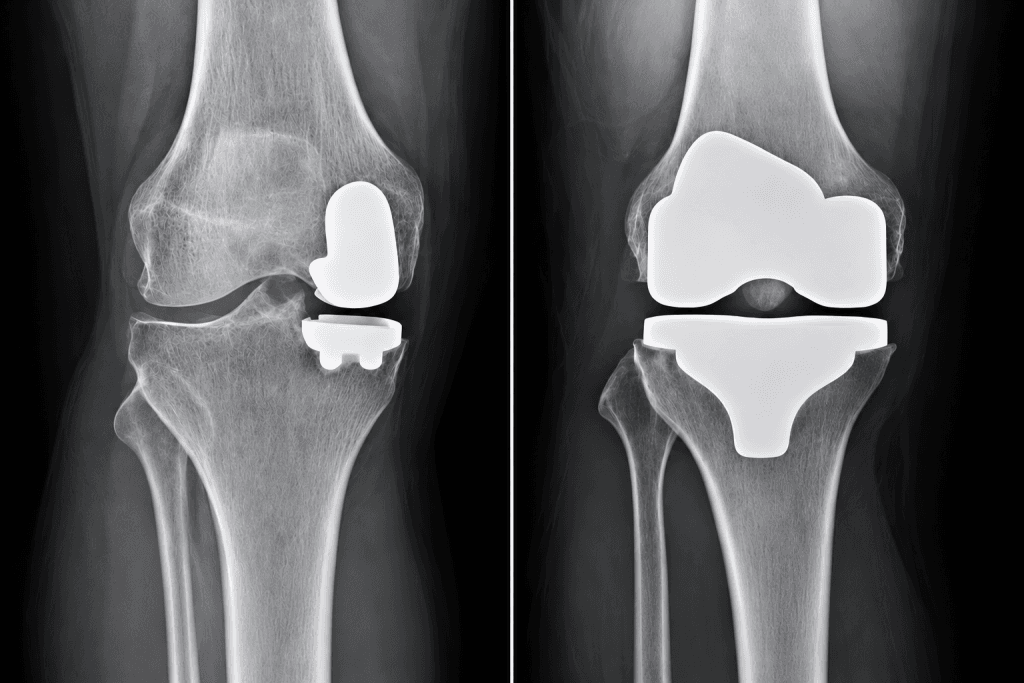
If you have been told that you have severe knee arthritis and may need a knee replacement, you may assume that the entire knee needs to be replaced.
That isn’t necessarily the case.
For some patients, arthritis is confined to just one part of the knee. In these situations, a partial knee replacement can replace the damaged area while preserving the healthy parts of the knee. For the right patient, this can offer important advantages over a total knee replacement, including a faster recovery and a more natural-feeling knee. The key is selecting the right patient.
What is a partial knee replacement?
The knee has three compartments:
- Medial compartment – the inner side of the knee
- Lateral compartment – the outer side
- Patellofemoral compartment – the joint between the kneecap and thighbone
Arthritis can affect one, two or all three compartments. A partial knee replacement, also called a unicompartmental knee replacement, replaces only the damaged compartment while preserving the remaining healthy parts of the knee. A total knee replacement, by comparison, replaces the surfaces of all three compartments.
This leads to a simple principle: Replace what is damaged. Preserve what is healthy.
How many people have arthritis in just one compartment?
Arthritis is not always spread throughout the knee. Studies suggest that approximately 25–47% of patients requiring knee replacement have arthritis predominantly confined to a single compartment and could potentially be considered for a partial knee replacement.
However, having arthritis in one compartment does not automatically make someone suitable. This is where careful assessment becomes important.
How many patients are actually suitable?
It is often quoted that around 30% of patients undergoing knee replacement may be suitable for a partial knee replacement.
Some studies have suggested an even higher proportion when suitability is based primarily on the pattern of arthritis seen on X-rays. However, when more stringent criteria are applied – including the condition of the other compartments, ligament function, knee movement, alignment and clinical symptoms – the number can be lower.
The location and severity of the arthritis, the condition of the rest of the knee, ligament function, alignment, movement and the patient’s symptoms and expectations all need to be considered.
Why might a partial knee replacement be better?
When a patient is genuinely suitable, there are several reasons to consider preserving the rest of the knee rather than replacing it.
More of your natural knee is preserved.
A partial knee replacement leaves the unaffected compartments untouched. It also preserves more of your natural bone and, in appropriately selected patients, the ACL and other native ligaments. This allows the replacement to work with the remaining structures of your knee rather than replacing them.
It can feel more natural
Because more of the original knee is preserved, including the normal ligaments in suitable patients, a partial knee replacement can retain more of the knee’s natural movement and biomechanics. Patients often describe the knee as feeling more like their own knee after recovery.
Recovery is generally faster
A partial knee replacement is generally less invasive than a total knee replacement.
Because less bone and soft tissue are disrupted, patients can often regain movement and function more quickly.
Less bone is removed
Only the damaged compartment needs to be resurfaced, preserving more of your native bone.
Future options are preserved
If a partial knee replacement eventually fails or arthritis develops in another compartment, conversion to a total knee replacement is usually possible.
Who is suitable for a partial knee replacement?
There is no single age or X-ray finding that determines whether someone is suitable. I consider several factors:
Arthritis confined predominantly to one compartment: This is fundamental. Significant arthritis throughout the knee generally makes a total knee replacement more appropriate.
Healthy remaining compartments: The lateral and patellofemoral compartments need to be healthy enough to justify preserving them.
Functioning ligaments: The ACL and other ligaments play an important role in the normal mechanics of the knee and need to function appropriately.
Good knee movement: Significant stiffness or a fixed deformity can make partial replacement less suitable.
Symptoms that match the arthritis: An abnormal X-ray does not necessarily mean that the arthritis seen is the cause of your pain.
Your goals and expectations: Age, occupation, sporting activities and lifestyle all form part of the decision.
This is why I don’t simply look at an X-ray and decide whether someone can have a partial knee replacement. The whole knee needs to be assessed.
Partial or total knee replacement – which is better?
A total knee replacement is an excellent operation and remains the right choice for many patients, particularly when arthritis affects multiple compartments of the knee. However, when arthritis is confined to one compartment and the rest of the knee is healthy, there are several potential advantages to choosing a partial knee replacement instead.
A partial knee replacement preserves more of your natural knee, including healthy cartilage, bone and, in appropriate patients, the ACL and other native ligaments. Because less of the knee is replaced, the procedure is generally less invasive and recovery is often faster.
The knee can also retain more of its natural movement and biomechanics, and many patients report that a well-functioning partial knee replacement feels more like their own knee. For an appropriately selected patient, these are significant advantages.
Importantly, this does not mean that a partial knee replacement is always better than a total knee replacement. The success of a partial replacement depends heavily on selecting the right patient in the first place.
What role does robotic surgery play?
Robotic-assisted surgery has become an important tool in modern partial knee replacement. The robot does not perform the operation independently. Instead, it assists with detailed planning and provides real-time information during surgery. This can be particularly valuable in partial knee replacement, where implant positioning, alignment and ligament balance are important.
However, technology is only one part of the equation. A robot cannot determine whether you are the right patient for a partial knee replacement. That decision requires careful clinical assessment and experience with both partial and total knee replacement.
The bottom line
Not every arthritic knee needs a total knee replacement.
If arthritis is isolated to one compartment and the remainder of the knee is healthy, a partial knee replacement can replace the damaged area while preserving much of your natural knee.
For the right patient, this can mean:
- Less bone removal
- Preservation of the natural ligaments
- A more natural-feeling knee
- Faster recovery
- Excellent pain relief and function
But partial knee replacement is not suitable for everyone. The most important step is identifying the patients in whom it is likely to provide the best long-term outcome.
My philosophy is simple: replace what is damaged, preserve what is healthy, and choose the operation that is right for your knee.
If you have been told that you need a knee replacement, it may be worth asking whether a partial knee replacement could be an option for you.