

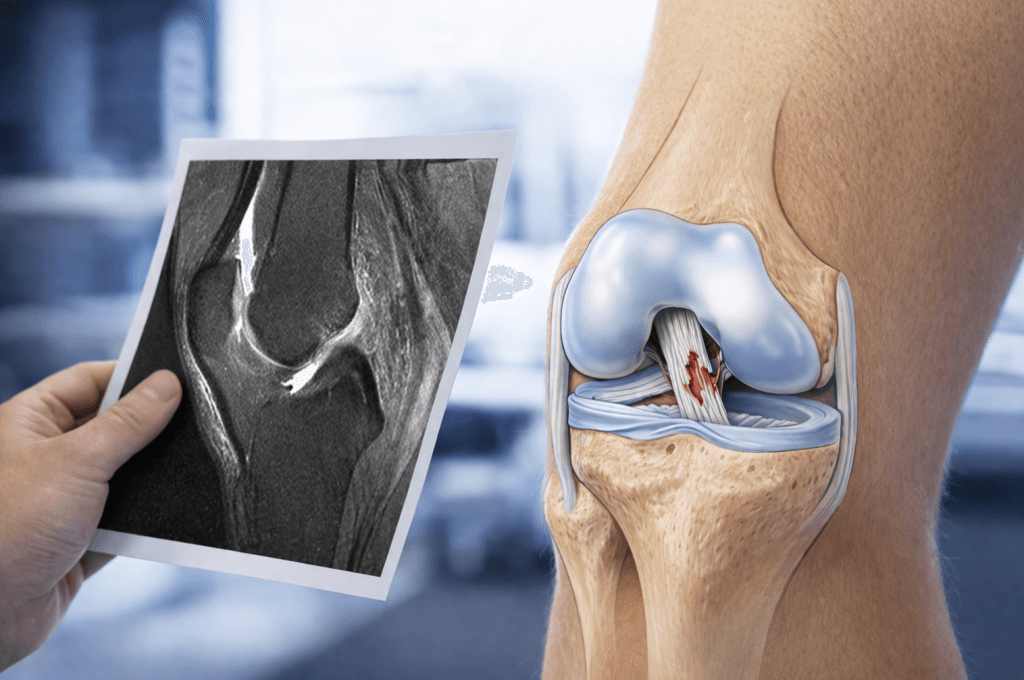
What is a partial ACL tear?
A partial ACL tear occurs when some fibres of the anterior cruciate ligament (ACL) remain intact after injury. It is a common diagnosis on MRI scans, particularly in patients who have injured their knee playing football, soccer, or netball. However, one of the most important things patients should understand is that not all partial ACL tears are the same. And more importantly, not everything labelled a ‘partial tear’ on MRI behaves like a true partial ACL tear.
Partial ACL tear vs complete ACL tear: why the difference matters
The key difference between a partial ACL tear and a complete ACL rupture is not just how the ligament looks – it’s how the knee functions. Some partial tears behave like stable knees and can usually be treated without surgery. Others behave like complete ACL tears, leading to instability and a higher risk of further injury to the meniscus or cartilage. This is why accurate diagnosis is critical.
Can an MRI accurately diagnose a partial ACL tear?
MRI is an important tool in diagnosing ACL injuries, but it has limitations. An MRI may show that some ACL fibres are still intact, leading to the diagnosis of a “partial tear.” However, MRI cannot reliably determine whether the ACL is functioning properly.
A ligament that appears partially intact on MRI may still behave like a non-functional ACL if it does not provide stability. This is where many patients are misdiagnosed.
The most important factor: physical examination
In my practice as a knee surgeon in Melbourne, the most important part of assessing a partial ACL tear is the clinical examination. This determines whether the ACL is still doing its job, and these tests provide far more information about knee stability than MRI alone.
If a patient demonstrates a high-grade Lachman and/or a high-grade pivot shift test, the knee is functionally unstable. Even if the MRI reports a “partial ACL tear,” this behaves like a complete ACL injury and should be managed accordingly.
A true partial ACL tear is more likely when the examination shows a low -grade Lachman test (minor asymmetry compared to the non-injured limb) and a low-grade or absent pivot shift. In this situation, the ACL is still contributing to knee stability.
Do partial ACL tears need surgery?
One of the most common questions patients ask is: “Do I need surgery for a partial ACL tear?” The answer depends on stability.
True partial ACL tears are often very suitable for non-operative treatment. Non-surgical management may include:
- Structured physiotherapy
- Strength and neuromuscular rehabilitation
- Gradual return to sport
Many patients can return to high-level activity without surgery – provided the knee remains stable.
When is surgery recommended for a partial ACL tear?
Surgery may be recommended if:
- The knee is unstable on examination
- There is a high-grade pivot shift
- The patient experiences ongoing giving way
- The patient wishes to return to pivoting or contact sports
In these cases, ACL reconstruction is often the safest option to restore stability and protect the knee long term. In some instances, ACL repair may be an option.
Refer to ACL reconstruction and ACL repair for further information on partial ACL tear surgery.
Why accurate diagnosis is essential
Misdiagnosis of a partial ACL tear can lead to poor outcomes. Overestimating stability may result in recurrent instability and further injury. Underestimating instability may delay necessary surgery. The key is assessing how the knee behaves, not just what the MRI shows.
Partial ACL tear treatment in Melbourne
If you’ve been diagnosed with a partial ACL tear and are unsure whether you need surgery, a detailed clinical assessment is essential.
As a Melbourne knee surgeon specialising in ACL injuries, I focus on accurate diagnosis, individualised treatment plans, and helping patients return safely to sport.
Key takeaways
- Not all partial ACL tears are the same
- MRI alone cannot determine ACL function
- Physical examination is critical
- True partial tears can often be treated without surgery
- The key is confirming that the tear is genuinely partial
When should you see a knee specialist?
You should consider seeing an Melbourne ACL specialist if you:
- Have been told you have a partial ACL tear
- Experience knee instability or giving way
- Want to return to sport safely
- Are unsure whether surgery is necessary