

When an athlete requires ACL reconstruction, one of the most important decisions is graft choice. Hamstring, patellar tendon, or quadriceps tendon – each has advantages, trade-offs, and specific indications. Despite the volume of information online, the reality is this: there is no single “best” graft, only the right graft for the right athlete.
As a Melbourne knee surgeon specialising in ACL surgery and sports knee injuries in both elite and recreational athletes, this article outlines how graft choice should be approached, and what actually matters when aiming for a safe return to performance.
Why graft choice matters
For athletes undergoing ACL reconstruction in Melbourne, the goal is not just to return to sport, but to return to pre-injury level performance, while minimising re-rupture risk, ongoing knee symptoms, and long-term joint degeneration. Graft choice influences all three.
The three main graft options
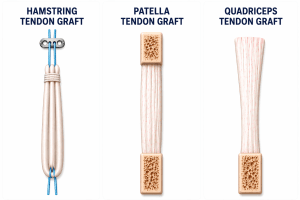
Hamstring tendon graft
Typically uses the semitendinosus (and sometimes gracilis) tendons. Advantages include less anterior knee pain, a smaller incision, and lower risk of kneeling discomfort. In athletes, however, hamstring strength deficits can persist, potentially impacting high-speed running and deceleration, and some studies suggest slightly higher graft failure rates in younger, high-risk athletes. It is often suitable for recreational athletes or those where anterior knee pain would be particularly problematic.
Patellar tendon (BTB) graft
This bone–tendon–bone graft from the patellar tendon offers excellent fixation strength and strong evidence for lower re-rupture rates in high-risk athletes, making it reliable for pivoting sports. However, it carries higher rates of anterior knee pain, kneeling discomfort, and risk of patellar tendon irritation. It is often preferred in AFL, soccer, rugby and high-level athletes who are returning to cutting and pivoting sports, particularly younger, high-demand individuals.
Quadriceps tendon graft
An increasingly popular option, the quadriceps tendon graft provides a large, strong graft with lower rates of anterior knee pain than patellar tendon grafts while avoiding hamstring weakness. Considerations include less long-term data (although growing rapidly) and the potential for early quadriceps weakness if rehabilitation is not well managed. It is a strong option for high-level athletes, revision cases, and situations where preserving hamstring strength is important.
What actually matters in choosing the best ACL graft?
Choosing the best graft isn’t just about the tissue, it’s about the athlete. Sport-specific demands are critical, as not all sports stress the knee in the same way. Pivoting and contact sports prioritise graft robustness and stability, while endurance sports may favour muscle preservation.
Athlete profile also plays a major role, including age, level of competition, previous injuries, and ligamentous laxity. An 18-year-old AFL player has very different requirements to a 35-year-old recreational runner.
Risk tolerance is another key factor; some athletes prioritise minimising re-tear risk, while others prioritise less pain or smoother early recovery.
Finally, the rehabilitation environment is often underestimated. A high-quality rehab program incorporating strength, power, and return-to-sport testing can be just as important as graft choice itself.
The biggest misconception about ACL surgery
The common belief is that the graft determines the outcome. In reality, surgery is only one component. Rehabilitation quality, load management, and return-to-sport testing are critical. Even the “best” graft can fail in a poorly managed system.
My approach as a Melbourne ACL surgeon
In high-demand athletes, my approach is to:
- Match graft choice to the individual athlete and sport
- Prioritise long-term knee health over short-term return
- Work closely with physiotherapists and performance teams
- Ensure objective return-to-sport criteria are met
ACL reconstruction is not just about getting back, it’s about getting back well.
When Should You See an ACL Surgeon in Melbourne?
You should consider specialist review if you have:
- Knee instability or “giving way”
- Confirmed ACL tear on MRI
- Desire to return to pivoting sport
- Failed non-operative management
Early assessment helps guide both ACL treatment options and timing of surgery.
Final thoughts
For athletes undergoing ACL reconstruction, graft choice is an important decision, but not an isolated one. The best outcomes come from thoughtful graft selection, high-quality surgery, and structured, performance-based rehabilitation.
If you’re an athlete, or managing one, understanding these factors helps ensure the focus stays where it should be: a safe and successful return to performance.